






🎓 Homework Deadline Looming?
Struggling with assignments, projects, or lab reports on this topic? Connect with our expert academic tutors to get personalized study support tonight.
Get Expert Help Now →Narrative Framework and Business Context
Goldratt and Cox embed complex operational theory inside a story that follows Alex, a plant manager under pressure to improve performance. The narrative structure allows readers to witness the cause‑and‑effect relationship of bottlenecks in real time, making abstract concepts tangible.
The industrial urgency depicted in the novel mirrors real‑world production pressures, where missed delivery dates and rising costs create a palpable sense of crisis. By portraying these stakes through characters, the authors turn a textbook into a living case study.
Character Jonah as a Conceptual Guide
Jonah, a physicist turned consultant, serves as the intellectual catalyst. His questions force Alex to confront hidden constraints, turning the plant’s chaos into a laboratory for learning. This character‑driven approach mirrors case‑based pedagogy used in MBA programs.
Key Operational Metrics Explained
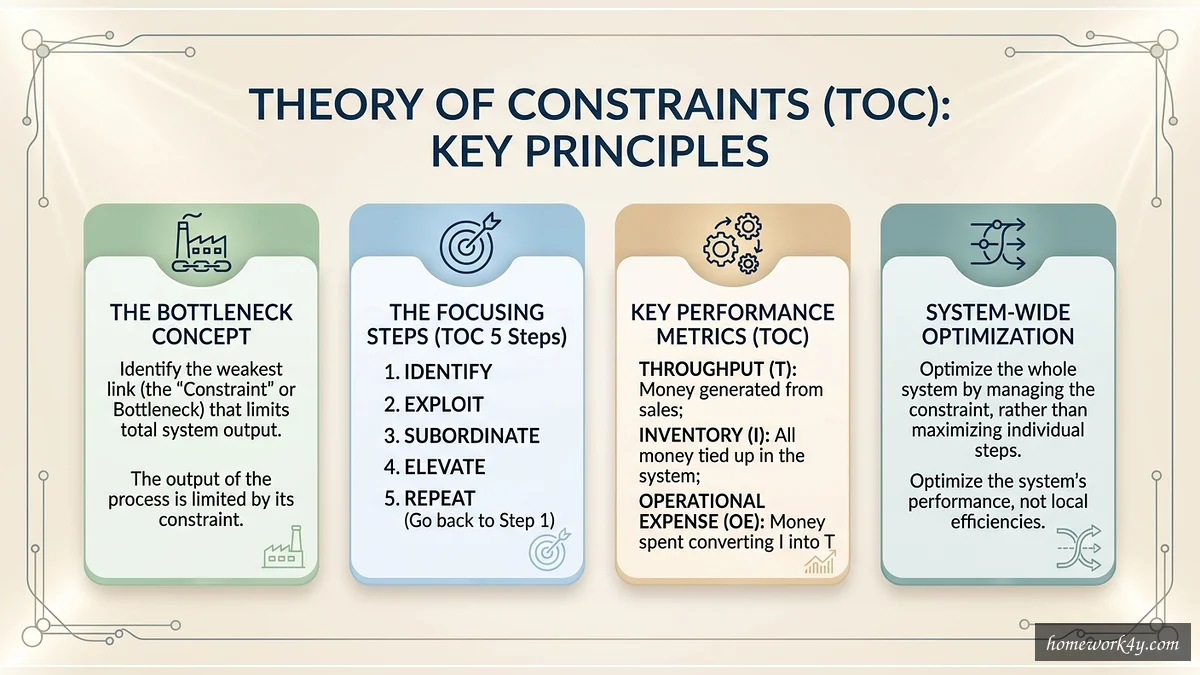
- Throughput – the rate at which the system generates money through sales.
- Inventory – all money tied up in the production process.
- Operational Expense – the cost of turning inventory into throughput.

| Metric | Definition | Narrative Example |
|---|---|---|
| Throughput | Revenue earned from completed products sold. | Alex discovers that increasing the speed of the bottleneck machine raises overall sales. |
| Inventory | Capital invested in raw materials, work‑in‑process, and finished goods. | Excess parts pile up before the NCX‑10, inflating inventory costs. |
| Operational Expense | All costs required to keep the plant running, excluding raw material cost. | Energy and labor expenses remain constant while output varies. |
Applying the Five Focusing Steps
The book structures improvement around five steps: identify, exploit, subordinate, elevate, and repeat. Each step is illustrated through Alex’s decisions, providing a template that managers can adapt to any production environment.
Identify the Constraint
Alex learns that the NCX‑10 machine limits the plant’s output. Recognizing this bottleneck is the first decisive action.
Exploit the Constraint
By ensuring the bottleneck works continuously and eliminating downtime, Alex extracts maximum value without additional investment.
Subordinate Other Processes
All non‑bottleneck activities are aligned to feed the NCX‑10 at its optimal rate, preventing excess work‑in‑process.
Elevate the Constraint
When exploitation reaches its limit, Alex adds a second NCX‑10, raising the system’s capacity.
Repeat the Cycle
After the first constraint is resolved, a new bottleneck emerges, prompting the next iteration of improvement.
Philosophical Implications for Modern Enterprises
Goldratt reframes the ultimate goal of any organization as money generation, not merely cost reduction. This perspective challenges traditional accounting that treats each department as an isolated profit center. By viewing the firm as a single, interdependent system, managers can prioritize actions that lift overall profitability.
Throughput‑Driven Decision Making
Decisions are evaluated based on their impact on throughput rather than on local efficiency metrics. This shift discourages over‑optimizing sub‑processes that do not contribute to the final product flow.
Inventory as a Liability
Inventory ties up capital and masks true performance. Reducing excess buffers uncovers hidden capacity and improves cash flow.
Operational Expense Management
Operating costs are scrutinized only after throughput and inventory are optimized, ensuring that expense cuts do not harm the system’s ability to generate revenue.
Integrating The Goal PDF into Academic Curricula
Graduate programs adopt the novel as a core text because it blends storytelling with rigorous analytical tools. Instructors use classroom simulations that replicate Alex’s plant, allowing students to practice constraint identification and solution design.
Assessment methods include timed case analyses, reflective essays on Jonah’s advice, and group presentations that map the five focusing steps onto real‑world data sets.
- Case studies focus on real‑world data sets.
- Group projects mirror the collaborative problem‑solving depicted in the book.
- Exams test the ability to apply the five focusing steps under time pressure.
Practical Takeaways for Operations Leaders
Leaders can translate the novel’s lessons into actionable initiatives:
- Map the current process flow to locate the true bottleneck.
- Implement a policy of continuous monitoring for constraint shifts.
- Invest in capacity upgrades only after full exploitation of existing resources.
- Align performance incentives with system‑wide throughput improvements.
Limitations and Academic Critiques
While the narrative approach engages readers, some scholars argue that the simplification of complex supply‑chain dynamics may overlook stochastic demand variations. Additionally, the focus on profit as the sole goal can conflict with emerging sustainability objectives.
Extensions and Modern Applications
Recent research expands TOC into project management (Critical Chain) and supply‑chain coordination (Drum‑Buffer‑Rope). These extensions preserve the core logic of constraint management while addressing multi‑echelon networks and service‑oriented environments.
Software platforms now embed TOC analytics, offering real‑time bottleneck detection, scenario modeling, and automated recommendation of exploitation strategies.
Conclusion
By weaving theory into a compelling narrative, The Goal PDF equips managers with a clear roadmap for sustainable improvement. Its emphasis on systemic thinking remains relevant across manufacturing, services, and digital platforms. Available in PDF format for academic reference.