



🎓 Homework Deadline Looming?
Struggling with assignments, projects, or lab reports on this topic? Connect with our expert academic tutors to get personalized study support tonight.
Get Expert Help Now →Introduction to Architectural Phenomenology
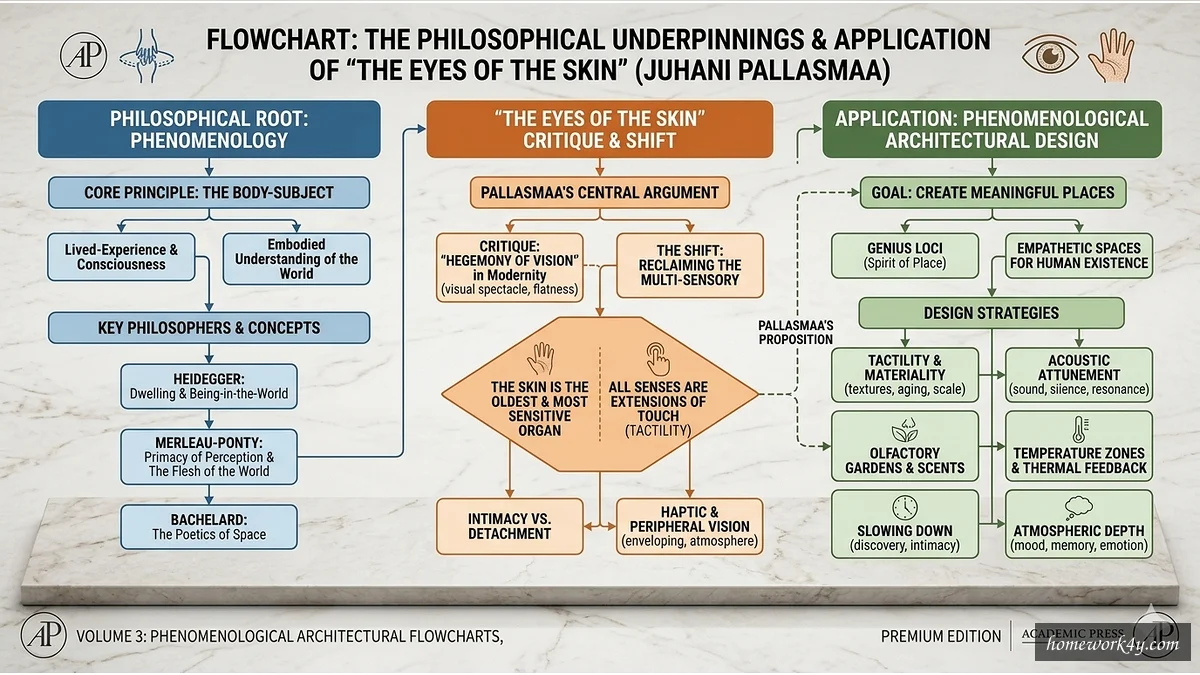
Pallasmaa's methodological approach, rooted in phenomenological philosophy, draws upon Maurice Merleau-Ponty's concepts to deconstruct the dominance of visual culture in modern architecture. This approach emphasizes the importance of considering the embodied human experience in architectural design, rather than solely focusing on visual aesthetics.Critique of Ocularcentrism
The Eyes of the Skin delivers a scathing critique of the cultural and historical bias that prioritizes visual dominance over other human senses. Pallasmaa argues that this bias has led to the production of flattened, purely visual images in modern architecture, designed for media consumption rather than physical human experience. This critique is central to understanding the need for a radical shift toward a multi-sensory, haptic architecture.Multi-Sensory Architecture
Pallasmaa's work advocates for an architectural approach that engages the entire human body, incorporating acoustic resonance, tactile textures, spatial shadows, thermal qualities, and olfactory elements to construct an authentic sense of place, belonging, and existential security. This approach requires a deep understanding of human biology and psychology, as well as a commitment to designing compassionate spaces that honor the multi-sensory complexity of the human experience.
Philosophical Underpinnings
The Eyes of the Skin is rooted in phenomenological philosophy, which emphasizes the importance of subjective experience and the role of the body in shaping our perception of the world. Pallasmaa's work draws upon the ideas of Merleau-Ponty, who argued that the body is not just a passive recipient of sensory information, but an active participant in the construction of our experience. This philosophical framework provides a foundation for understanding the significance of multi-sensory architecture and its potential to foster deep emotional, cognitive, and spiritual healing.Educational and Societal Implications
The Eyes of the Skin serves as an indispensable pedagogical resource, challenging future architects, interior designers, and urban planners to reject cold, hyper-rationalized geometries and instead engineer compassionate spaces that honor the multi-sensory complexity of the human experience. This text has far-reaching implications for the way we design and interact with built environments, emphasizing the need for a more holistic and human-centered approach to architecture.| Concept | Description | Implications |
|---|---|---|
| Ocularcentrism | Cultural and historical bias that prioritizes visual dominance over other human senses | Leads to the production of flattened, purely visual images in modern architecture |
| Multi-Sensory Architecture | Architectural approach that engages the entire human body, incorporating multiple senses | Fosters deep emotional, cognitive, and spiritual healing; constructs an authentic sense of place, belonging, and existential security |
| Phenomenological Philosophy | Emphasizes the importance of subjective experience and the role of the body in shaping our perception of the world | Provides a foundation for understanding the significance of multi-sensory architecture and its potential to foster deep emotional, cognitive, and spiritual healing |