



🎓 Homework Deadline Looming?
Struggling with assignments, projects, or lab reports on this topic? Connect with our expert academic tutors to get personalized study support tonight.
Get Expert Help Now →Introduction to Garfinkel's Breaching Experiments
Harold Garfinkel's breaching experiments, as outlined in his seminal work "Studies in Ethnomethodology," represent a foundational shift in the study of social order and practical reasoning. By intentionally disrupting everyday interactions, Garfinkel's methodological approach reveals the intricate mechanics of social norm construction and maintenance. This approach challenges the traditional structuralist view of society, instead highlighting the active and continuous achievement of social order through daily cognitive rationalization.Methodological Approach of Breaching Experiments
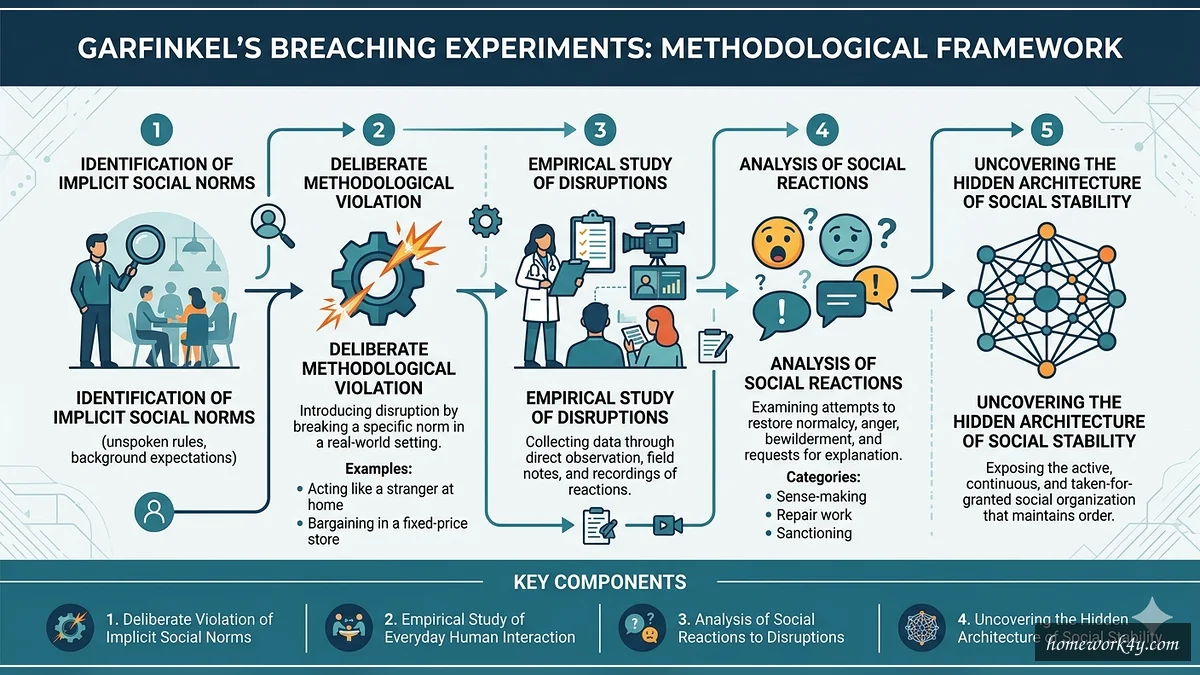
Garfinkel's breaching experiments involve the deliberate violation of "background expectancies," or the unspoken rules of engagement that govern social interactions. By analyzing social reactions to these disruptions, including confusion, indignation, and efforts to restore order, researchers can uncover the hidden architecture of social stability. This methodological approach relies on the empirical study of everyday human interaction, providing a unique window into the micro-politics of institutional conformity.
Philosophical Underpinnings of Breaching Experiments
The philosophical underpinnings of Garfinkel's breaching experiments challenge the notion that social order is an external force imposed upon individuals. Instead, the experiments demonstrate that social order is an active and fragile achievement, generated through the continuous cognitive rationalization of daily interactions. This perspective highlights the importance of understanding social reality as a dynamic and constructed phenomenon, rather than a fixed or static entity.Education and Societal Implications of Breaching Experiments
The Garfinkel breaching experiment has significant implications for education and society. As a pedagogical asset, the experiment trains future sociologists to analyze the hidden architecture of social stability and the micro-politics of institutional conformity. By understanding how social norms are constructed and maintained, individuals can develop a deeper appreciation for the complexities of social interaction and the importance of critically evaluating the social world around them.Core Principles of Breaching Experiments
The core principles of Garfinkel's breaching experiments can be summarized as follows:- Deliberate violation of implicit social norms
- Empirical study of everyday human interaction
- Analysis of social reactions to disruptions
- Uncovering the hidden architecture of social stability
- Challenging the traditional structuralist view of society
Comparison of Breaching Experiments with Other Research Methods
The following table compares Garfinkel's breaching experiments with other qualitative research methods:| Research Method | Description | Key Features |
|---|---|---|
| Garfinkel's Breaching Experiments | Deliberate violation of implicit social norms to uncover social reality | Empirical study of everyday interaction, analysis of social reactions |
| Participant Observation | Immersion in a social setting to observe and participate in interactions | Long-term engagement, detailed field notes, reflexive analysis |
| Interviews | In-depth conversations with individuals to gather data on their experiences | Open-ended questions, active listening, thematic analysis |